
Forcepoint vs Safetica: How to Choose Between Enterprise DLP and Cloud-Native SaaS DLP
12 July 2026 · 3 min read · Cloud Armor Security Team
- DLP
- Forcepoint
- Safetica
- Vendor Comparison
TL;DR — Forcepoint and Safetica are both excellent DLP products solving the same problem with different architectures. Forcepoint wins in deep, regulated, infrastructure-heavy estates (defence, large BFSI, air-gapped environments). Safetica wins where the mandate is cloud-native SaaS, fast rollout and lean operations. The deciding factor is your estate and operating model — not a feature checklist.
Most "vs" articles are written by one of the two vendors. This one is written by a team that deploys both — including Forcepoint at a defence joint venture and Safetica at Vedanta Power, where the client's requirement was explicitly a cloud-native SaaS tool.
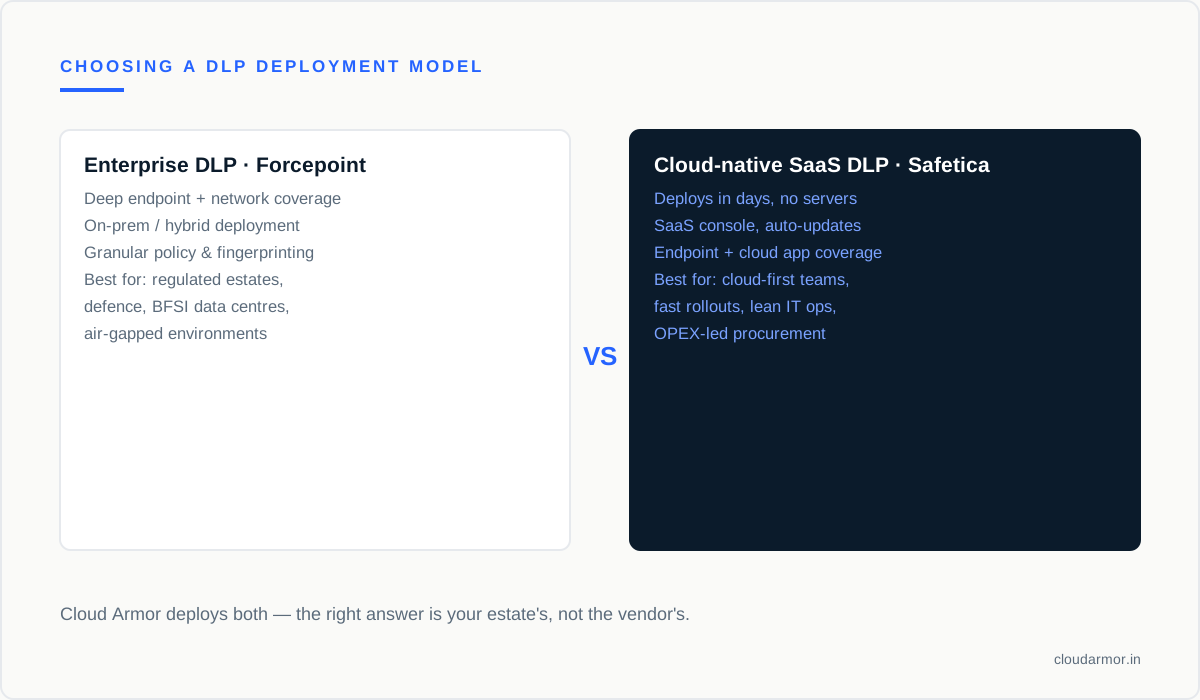
The comparison that matters
| Dimension | Forcepoint DLP | Safetica |
|---|---|---|
| Architecture | On-premises / hybrid management infrastructure | Cloud-native SaaS console, agents only on endpoints |
| Time to first value | Weeks-to-months (infrastructure + policy) | Days (tenant + agents + starter policies) |
| Coverage depth | Very deep: fingerprinting, OCR, network DLP, granular endpoint channels | Strong endpoint + cloud-app coverage; lighter on specialised network DLP |
| Best-fit estates | Defence, large BFSI, data-centre-centric, air-gapped or data-residency-strict | Cloud-first, distributed workforces, lean IT teams |
| Operations burden | Needs owned infrastructure and administrator depth | Vendor-operated backend; policy work only |
| Buying model | Traditional enterprise licensing | SaaS subscription (OPEX) |
| Compliance evidencing | Extensive, enterprise-audit-grade | Solid reporting fit for DPDP/ISO-style evidence |
When Forcepoint is the right answer
- Your crown jewels justify document fingerprinting — exact-match detection of design files, contract families or bulk records
- You operate regulated or air-gapped infrastructure where a SaaS control plane is not acceptable
- You need network-level DLP (egress inspection) alongside endpoints
- You have (or are buying) the administrator depth to run it properly
This is the profile of our defence-manufacturing and large-BFSI deployments — see the KRAS, Thermal Systems and Insurance Information Bureau of India case studies.
When Safetica is the right answer
- The mandate is "no new servers" — cloud-native SaaS, explicitly
- You need protection live in days, not a quarterly programme
- A lean IT team will operate it alongside everything else they do
- Your data flows are endpoint- and cloud-app-shaped, not data-centre-shaped
That was precisely Vedanta Power's brief, and why we recommended Safetica — the full reasoning is in the case study.
The mistake to avoid: buying architecture you won't operate
The most expensive DLP failure mode is not choosing the "weaker" product — it is choosing the heavier product without the operating capacity to run it. An enforcing Safetica beats a shelfware Forcepoint every single day. Match the tool to the team, then execute the same discipline either way: discover → classify → monitor → enforce, as laid out in our DLP implementation checklist.
Frequently asked questions
Can we run Forcepoint and Safetica together?
It is rarely worth it. Pick one per estate; if you have genuinely distinct estates (e.g. an air-gapped facility plus a cloud-first business unit), a two-vendor answer can make sense — with unified policy governance above both.
Which is cheaper?
Safetica's subscription model usually carries a lower total cost for small-to-mid estates once infrastructure and administration are counted. At large scale with deep requirements, the comparison narrows — model the three-year TCO including people, not just licences.
We're BFSI — does the regulator care which we pick?
No. RBI, IRDAI and the DPDP Act care that leakage prevention demonstrably operates. Our BFSI DLP compliance guide maps the obligations either product can satisfy — when properly run.
Want the recommendation for your estate? Cloud Armor is multi-vendor by design — talk to our DLP engineers and get the answer your architecture points to, with the evidence to defend it.
Blog timeline
Explore the full series
27 July 2026 · 4 min read
Wazuh vs Commercial SIEM: The Real Enterprise Trade-off
27 July 2026 · 3 min read
Managed SOC & SIEM With Data Residency in India
26 July 2026 · 3 min read
Choosing an MSSP in Hyderabad, Dubai & the GCC
26 July 2026 · 8 min read
IBM QRadar Alternatives: Ayati One as a Managed SIEM + AI-SOC
25 July 2026 · 3 min read
An Arctic Wolf Alternative for India: Pricing & Residency
24 July 2026 · 2 min read
A Rapid7 InsightIDR Alternative: Managed, In-Region SIEM
23 July 2026 · 3 min read
A Microsoft Sentinel Cost Alternative: Beyond Per-GB Pricing
22 July 2026 · 3 min read
IBM QRadar Migration: A Practical Path Off QRadar
21 July 2026 · 3 min read
RBI Cybersecurity Framework: SOC Monitoring & 6-Hour Reporting
20 July 2026 · 3 min read
SEBI CSCRF Compliance: SIEM, SOC & the M-SOC Option
19 July 2026 · 3 min read
UAE NESA/SIA & Dubai ISR: Security Monitoring for Compliance
18 July 2026 · 3 min read
IRDAI 2023 Cyber Security Guidelines: SOC, VAPT & Reporting
18 July 2026 · 3 min read
The Enterprise DLP Implementation Checklist: What Most Rollouts Miss
17 July 2026 · 3 min read
DPDP Act & Rules 2025: Breach Detection & 72-Hour Notification
15 July 2026 · 4 min read
Data Loss Prevention for BFSI in India: The RBI, IRDAI and DPDP Act Compliance Guide
12 July 2026 · Currently reading
Forcepoint vs Safetica: How to Choose Between Enterprise DLP and Cloud-Native SaaS DLP
10 July 2026 · 3 min read
IAM vs SSO: What's the Difference, and What Does Your Enterprise Actually Need?
8 July 2026 · 3 min read
Business Email Compromise in BFSI and Pharma: A Layered Defence Playbook
5 July 2026 · 3 min read
Pharma Cybersecurity: Protecting Drug IP, Clinical Trial Data and GxP Systems
Put this into practice.
Our engineers deliver what these guides describe — from assessment to a running control. Bring us your environment.