
Cybersecurity Incident Response Management
Detection is the easy part. Ayati One turns every alert into an owned, time-bound incident that someone is accountable for closing.
Overview
Most organisations do not have a detection problem — they have a follow-through problem. Alerts fire, someone glances at them, and the ones that mattered are identified afterwards, in the post-mortem. Incident response management is the discipline that closes that gap: a defined path from the moment something is detected to the moment it is provably resolved, with an owner and a clock attached at every step.
In Ayati One this is not a separate ticketing tool bolted onto a SIEM. A detection raised by the rule engine becomes an incident in the same platform that holds the telemetry, so the evidence, the affected asset, its software inventory, its vulnerability posture and its history are all one click from the case. The analyst never has to reconstruct context across three consoles at two in the morning.
Every incident carries a human-readable reference (INC-000412), a severity, a mapped MITRE ATT&CK technique where the detection supports one, and an SLA due time calculated the instant it is raised. Nothing sits in an undifferentiated queue waiting to be noticed.
What's included
Incident Response capabilities
A structured response lifecycle
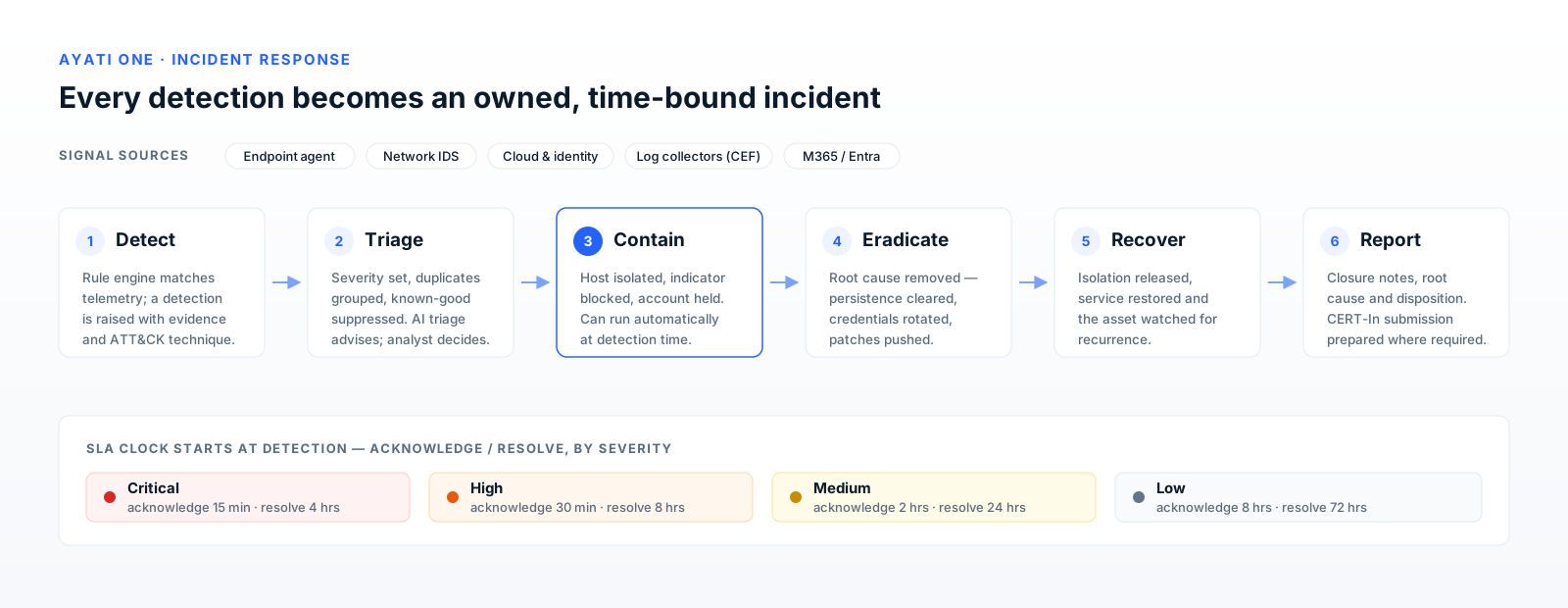
Detect, triage, contain, eradicate, recover, report — the phases NIST and SANS both describe, implemented as the actual path a case takes through the console rather than a policy document nobody opens. Each phase change is recorded against the incident.
Severity-driven SLA clocks
Acknowledge and resolve targets are set per severity and start at detection. The shipped policy is 15 minutes to acknowledge and 4 hours to resolve for critical, 30 minutes and 8 hours for high, 2 hours and 24 hours for medium, 8 hours and 72 hours for low — all editable to match the commitments you have made to your own business.
Automatic breach detection
A background sweep continuously checks open incidents against their due time and raises a breach notification to the owner and watchers the moment one is exceeded. An SLA you cannot see being missed is not an SLA.
Evidence attached, not referenced
The triggering events, the matched rule, the raw evidence payload and the affected asset travel with the incident. Investigation starts from what was actually observed, rather than from a summary line that has lost the detail.
MITRE ATT&CK technique mapping
Detections carry the adversary technique they correspond to, so an incident is legible as attacker behaviour — credential dumping, lateral movement, persistence — and your coverage gaps become visible as a map rather than a feeling.
AI-assisted triage that stays advisory
An optional AI pass summarises what appears to be happening, the likely severity and the recommended next steps, bounded by a defensive-only skill library. It is explicitly advisory — it never executes an action — and if the model is unavailable the platform falls back to deterministic triage so the workflow never stalls.
Cross-module correlation
An asset or IP address showing up across SIEM detections, cloud logs, identity events, hardening drift and vulnerability data is correlated into a single cross-module incident, rather than six unrelated alerts that only a very alert human would connect.
CERT-In reporting support
For Indian entities under the CERT-In six-hour reporting directive, an incident can be previewed and submitted in the required format from the case itself — with the detail already captured rather than reassembled under deadline pressure.
Operated 24×7, not just available
Cloud Armor analysts work the same queue you do, across our India, UAE and US operations. The platform is the system of record; the round-the-clock coverage is what makes response times real.
The rest of the platform
Asset Telemetry
Deep, continuous visibility into every endpoint and server — hardware, software, patches and posture.
SIEM with SOC Capabilities
Network monitoring, case management, threat intelligence and reporting — run as one SOC.
Case Management & Workflow Tracking
Incidents are treated as cases with assigned owners, timelines and actions — so nothing depends on somebody remembering.
Automated Incident Response (SOAR)
Predefined actions fire the instant an incident is detected — containment at machine speed, with human judgement kept where it belongs.
DMARC & Dark Web Monitoring
Stop attackers spoofing your domain, and know the moment your data surfaces where it shouldn't.
Code Security in the DevOps Pipeline
Static analysis wired directly into CI/CD — findings before merge, not after breach.
Scope Incident Response against your environment
A 30-minute conversation with our engineers is usually enough to map your requirement to a concrete plan and honest estimate.